ODE / OUR PURPOSE
We exist to make art part of how people live well
ODE connects artists, people and places through art chosen for the way it can shape human experience.
Art for how you want to feel.
Why we exist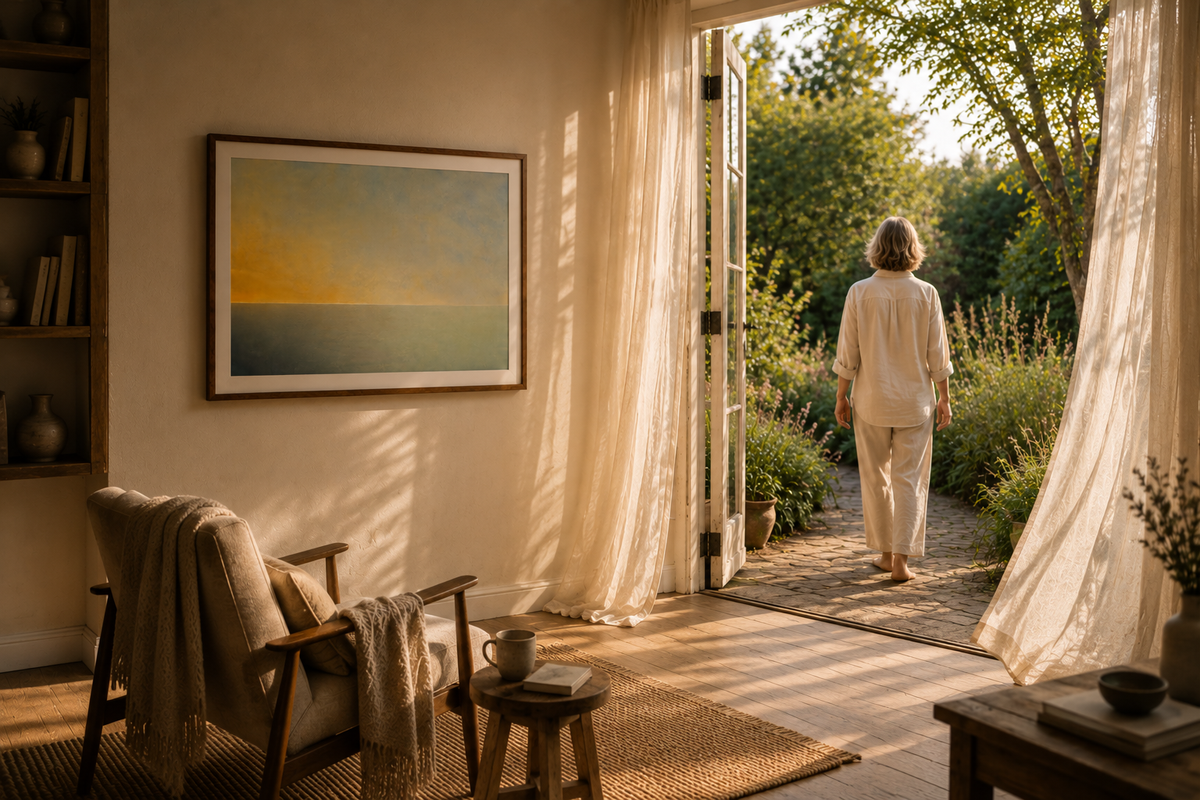
THE ODE METHOD
A belief needs a way of working.
Our method draws on art, perception, neuroaesthetics and environmental psychology. It helps us ask better questions without pretending that human response can be reduced to a formula.
Human need
What should this work give the person who lives with it? Rest, focus, warmth, energy, wonder.
Emotional impact
How does it actually make you feel — at first sight, and after a hundred days?
Visual language
Colour, rhythm, scale and material: how the work will live in a real room.
Selected
Only then does it become part of ODE — with a clear reason we can put into words.
INFORMED, NEVER PRESCRIBED
Research helps us ask better questions.
Art remains open-ended
We draw on neuroaesthetics, environmental psychology and perception to understand how people respond to light, rhythm, scale, visual complexity and space.
- Neuroaesthetics
- Environmental psychology
- Perception
- Attention
- Emotion
Research does not tell us exactly how a work will make someone feel. It gives us a more careful way to think about attention, memory and atmosphere. Every choice remains a human, artistic decision.
A letter from the founder
ODE began with a question: what if art played a larger role in how we live?
I’m Karst, the founder of ODE. After years of building ideas and organisations around innovation and change, I kept returning to one question: why do we pay so much attention to what people do, but so little attention to how the spaces around them make them feel?
I started ODE because I believe art deserves a more active role in our lives. Not simply as something we hang on a wall, but as something that can shape attention, atmosphere and the experience of being somewhere.
ODE is the beginning of that idea: connecting artists, people and places through art chosen with human wellbeing in mind.
EXPLORE ODE
There is more than one way to begin
-
With a feeling
The Art Worlds
Explore works chosen for how you want to feel.
Begin here -
With a room
Personal Art Selection
Three works, chosen for you and your space. €250, credited in full.
Begin here -
With a space
Businesses & Spaces
Art for how a place should feel — for the people in it.
Begin here -
With your work
For artists
One work and one line about what it does. That's enough to start.
Begin here
Curious how we think? Read the Art Journal
ART FOR HOW YOU WANT TO FEEL
Let art take a more active place in your life
Begin with the feeling, and let the work follow.